

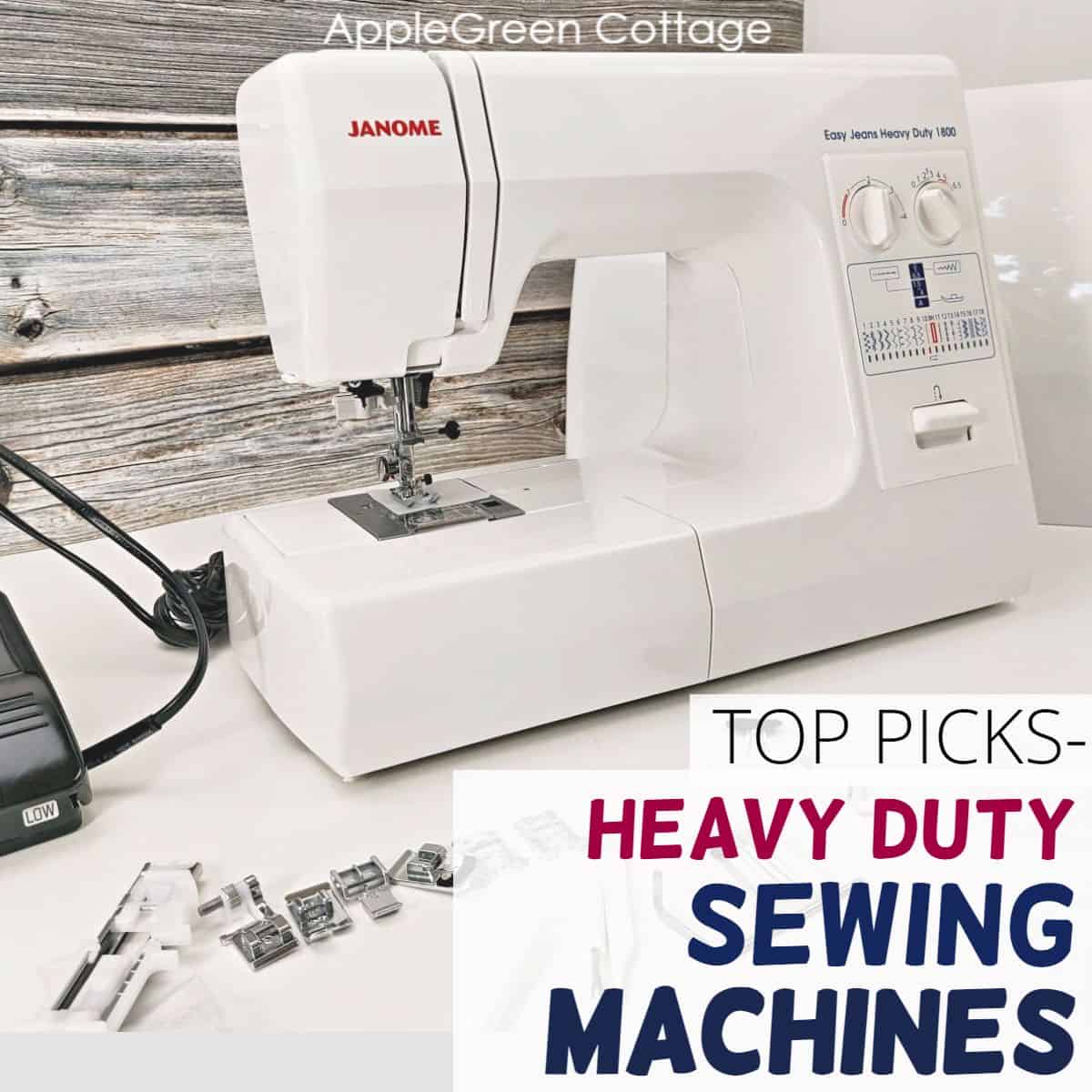
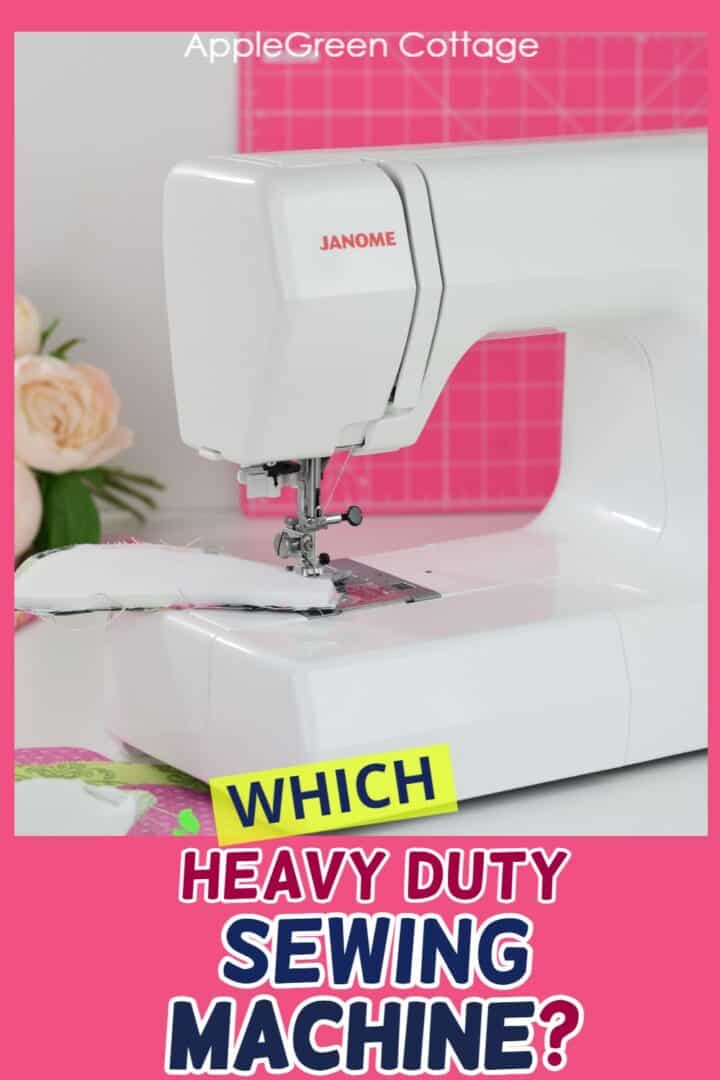
Is your sewing machine struggling when sewing through multiple layers? Maybe it's time for a heavy-duty sewing machine. Here are my top picks for the best heavy-duty sewing machines - ones I was deciding among when picking my own hd machine. (I now have 2 of these HD machines - see below why I chose them.)
If you are new to HD sewing machines, fear not - I'll guide you through everything: from what it is, when you need it, and which models might be suited best for your budget.
You'll also find out the difference between a domestic and an industrial HD sewing machine, as well as my best tips on what to look for when getting an HD sewing machine. Also, unboxing video and a detailed review of my own household heavy-duty sewing machine.
EDIT: you'll notice I've recently purchased my new →Janome HD9 If you're serious about heavy-duty sewing, this high-performance machine is in a class of its own.
If you're looking for more information on sewing machines, or are starting to use a sewing machine, check out the learn to sew page.
Best Heavy-Duty sewing machines summary:
Table Of Contents
- Best Heavy-Duty sewing machines summary:
- 3 Main Types of Heavy-duty sewing machines
- What is a Heavy Duty home sewing machine?
- When Do You need an HD Sewing Machine?
- I made 2 bags: one on Janome HD1800, and one on Janome HD9
- Janome HD 3000 and Janome HD 1800
- JANOME HD3000 HEAVY-DUTY SEWING MACHINE
- Differences Between HD3000 and HD 1800
- Janome HD3000 vs Janome HD1000 comparison
- Singer 4423 Heavy Duty Sewing Machine
- Singer 4423 vs Janome HD 3000
- Elna 3210 Easy Jeans (Also called Elna Easy Jeans)
- Elna 3210 Easy Jeans vs Janome HD1800
- Semi-Industrial Heavy Duty Sewing Machines
- Juki TL-2010Q Straight-Stitch Sewing Machine
- Janome HD9
- Juki TL-2010Q vs Janome HD9 Comparison
- Janome HD1800, HD2200 vs Janome HD9 motor power - Comparison
- Conclusion
- Want More Free Patterns?
- Best for occasional bagmaking: Janome HD3000
- Most popular for beginners: Singer 4423 Heavy Duty
- Best for Professionals: → Janome HD9
NOTE: →Janome HD9 If you're serious about heavy-duty sewing, this high-performance machine is in a class of its own.
3 Main Types of Heavy-duty sewing machines
- Home HD Machines: Perfect for hobbyists and small-scale heavy sewing projects.
- Industrial HD Machines: Designed for high-volume, professional use but require more space.
- Semi-Professional HD Machines: Like the Janome HD9 or Juki TL-2010Q, they combine industrial power with the portability and flexibility of home machines. Note these are straight-stitch only! (I'll explain this in a bit.)
Here's an example of a Comparison Table showing you the three types of heavy-duty sewing machines:
| Category | Best For | Key Features | Price Range | Mobility |
|---|---|---|---|---|
| Home HD Machines | Hobbyists, small-scale projects | Compact, easy-to-use, handles thick fabrics | 300–1,000 USD | Medium-weight, portable |
| Semi-Professional (straight-stitch!) HD | Advanced sewists, small businesses | Industrial-level power without bulk, high-speed precision | 1,000–2,500 USD | Moderate weight, easy to move. (straight-stitch!) |
| Industrial HD | Large-scale, professional production | Highest speed and power, built-in table, designed for heavy use | 2,500+ USD | Stationary due to built-in table |
What is a Heavy Duty home sewing machine?
First, let me clarify this question I frequently bump into: this is a type of sewing machine designed to handle tough fabrics and thicker materials such as denim, canvas, and leather - better.
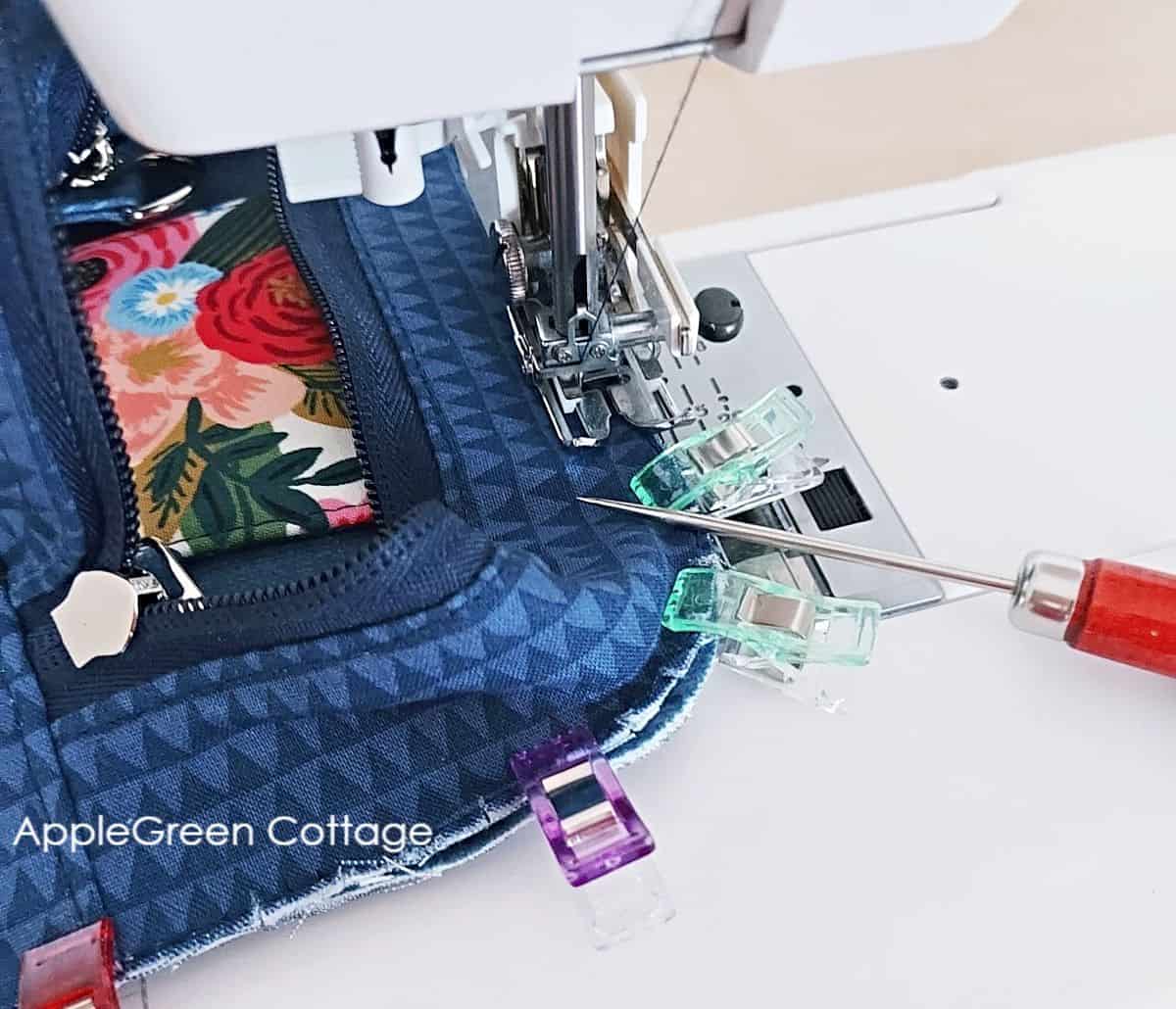
These machines may still be in the home-sewing range, but built so that they can handle some extra workload - and can sew through more layers. They are ideal for sewing projects that require more strength and durability, such as occasional bagmaking, and heavier home decor. This is me making the Metroloop Bag using the Janome HD1800 machine:
However, they are still weaker than industrial sewing machines, most of them with the raw motor power pretty close to the regular machines. Industrial sewing machines are an entirely different story, for a different post about sewing machines. Specialized, heavy-weight. Now, to the second-most frequent question:
When Do You need an HD Sewing Machine?
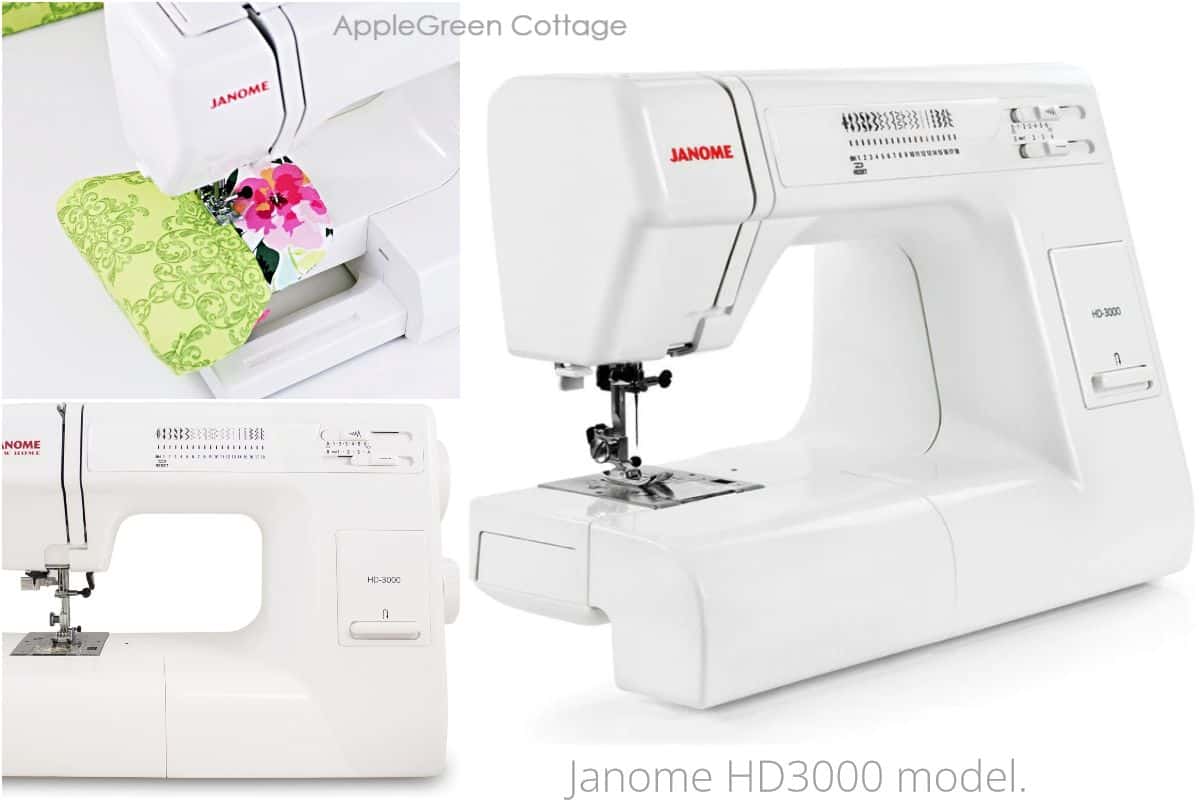
If you are looking for a machine that will handle sewing up a wallet pattern like this one (or any of these patterns actually) - you can do everything on a regular home sewing machine. All AppleGreen Cottage patterns are designed work on domestic machines, yes.
However, if you are looking for a machine that deals with all of these even easier, and more comfortably, and also want to sew up a few patterns you have always wanted to try but are not exactly suited for a basic machine, then a budget, domestic heavy-duty machine is the way to go: an easy to use, simple non-computerized HD sewing machine.
An aspiring bagmaker? It's a no-brainer: definitely go for an HD sewing machine!
Difference Between a Domestic Heavy-Duty Sewing Machine and an Industrial Heavy-Duty Sewing Machine
The main question to answer here is: When do you need an industrial or professional sewing machine?
For me, the only time you really need an industrial sewing machine is when you're regularly sewing heavy, stiff materials or working with multiple thick layers. Industrial machines are true workhorses, designed for speed, power, and durability, with specialized components for intensive use.
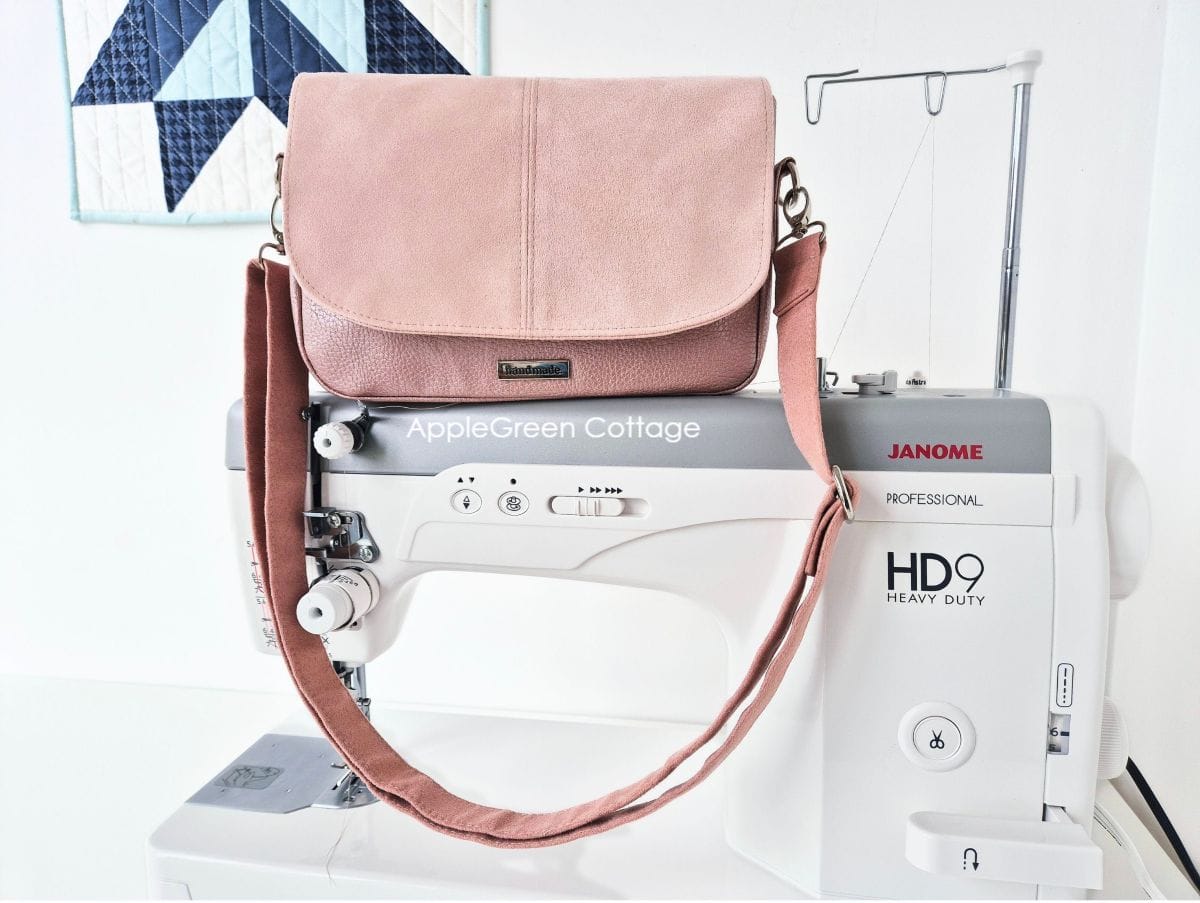
If you're starting a bag-making business, especially one that involves a lot of leather or similar tough materials, an industrial machine is worth the investment. However, for most hobbyists or small-scale sewing projects, a domestic heavy-duty sewing machine is the perfect choice. These models are more versatile, easier to move, and generally more affordable.
Below, I'll cover two classes of heavy-duty machines: domestic heavy-duty sewing machines and professional/industrial heavy-duty machines to help you understand which might work best for you. And the one in between.
1 - Domestic Heavy-Duty Sewing Machines
Domestic heavy-duty sewing machines, like the Janome HD1800 I first purchased, are excellent for everyday heavy sewing. They handle thick fabrics, multiple layers, and tough projects with ease, while still being user-friendly and portable.
These machines are ideal for hobbyists or small-scale bag-makers who need a powerful yet approachable machine. Their compact size and ease of movement make them a great choice for those who want heavy-duty performance without the bulk of an industrial setup.
2 - Industrial Heavy-Duty Machines
Industrial sewing machines are in a class of their own. Designed for high-speed, heavy-duty sewing, they excel in environments where production volume is key. They're built for speed and precision, easily sewing through thick materials like leather or canvas for hours on end.
However, most industrial machines come with integrated, heavy-duty sewing tables as part of the setup. These tables provide stability and durability but also make the machine bulky and stationary. For those with limited space or the need for flexibility, this can be a significant drawback.
3 - The Janome HD9: A Professional Heavy-Duty Option Without the Bulk
The Janome HD9 feels like an industrial machine, but in the best possible way - the power, speed, and precision, without that huge built-in table taking over my sewing space.
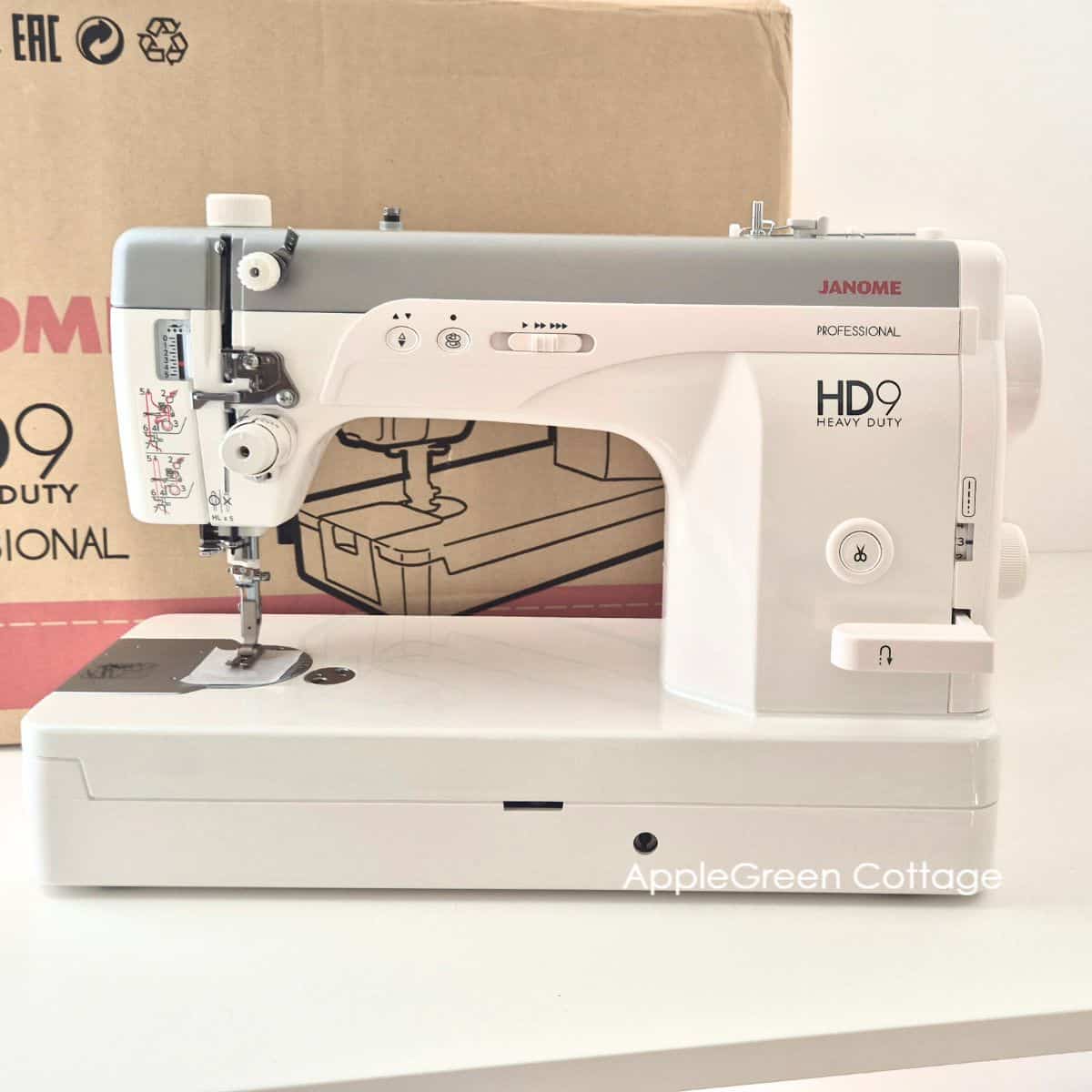
It fits right into a regular sewing corner, and still handles the heavy work beautifully. For me, the perfect middle ground!
My Recommendation
If you're a hobbyist or sew casually, start with a domestic heavy-duty machine like the Janome HD3000 or HD1800, . They're powerful, portable, budget-friendly - and since they do zigzag as well as straight stitch, you'll still have plenty of flexibility.
But if you're dreaming bigger - sewing bags all the time, working with leather or heavy layers, or maybe even starting a business (and occasionally quilting too!) - oh I'd go straight for the Janome HD9! It's straight-stitch only, yes, but what you get in return is speed, strength, and precision that feels industrial - without the giant table taking over your sewing space.
I made 2 bags: one on Janome HD1800, and one on Janome HD9
Just for reference: I sewed my latest bag pattern prototype on the HD1800 (~HD3000), and another one on the HD9 a few days after. Both handled the thick seams well, though I did have to hand-crank through the bulkiest part on the HD3000, while the HD9 handled it like a breeze - I haven't even come close to pushing it to its limit. (see both bag photos in my shop)
Note: I haven't included industrial machines in this comparison due to their pricing and different market segment. I'll hopefully write a detailed comparison between the HD9 and its industrial competitors soon!
Why I bought a household heavy-duty home sewing machine? (two!)
When buying my 'first' HD home sewing machine, I wanted a simple, mechanical, but stronger-than-regular sewing machine. An affordable, yet sturdy model for my sewing projects. I don't need a giant sew-through-everything industrial in my sewing corner (and most probably you neither).
After a lot of research and time spent, I narrowed it down to 3, 'for-my-needs' best heavy-duty sewing machine models:
My 3 Top Picks as Best heavy duty sewing machines
- Janome HD3000 which had fantastic reviews for the use I was looking for, but is not available where I live
- so I went with Janome HD1800 (which is a European equivalent to Janome HD3000 with nearly all features identical, just another name - see detailed comparison and review below.)
- Singer 4423
- Elna 3210 Easy Jeans
Let me show you how they differ, it might help you decide if you too are looking for one of these to buy. First, all the details I found important about my newest heavy-duty machine:
Janome HD 3000 and Janome HD 1800
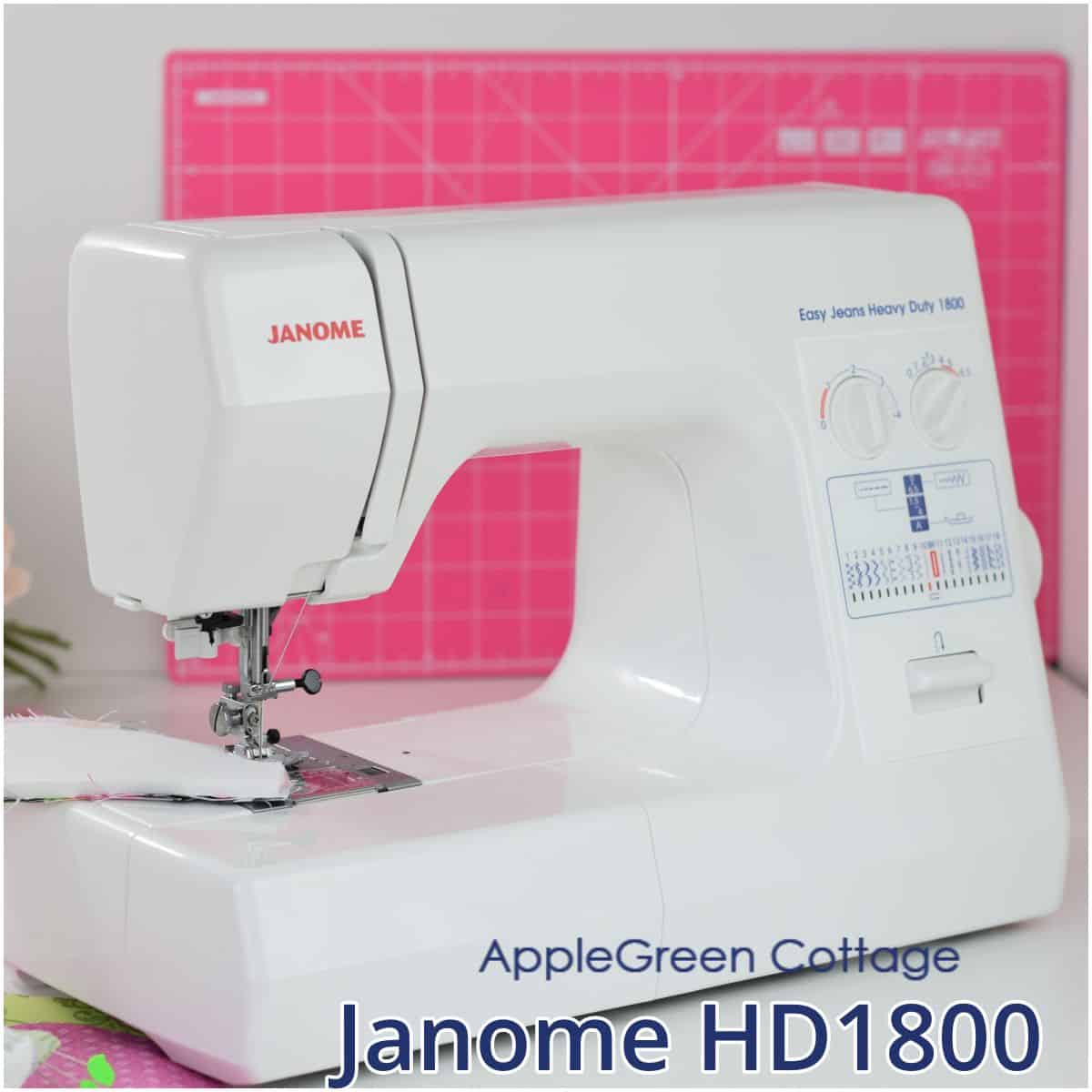
My Janome HD1800 Sewing Machine Review
While the key features of the main Janome HD models HD1000, HD3000, and HD5000 differ, HD3000 has been the most popular among those in the budget range. In Europe, that is HD1800. For good reasons.
Let me first show you a quick unboxing video so you can see what it includes (if you can't see the video, pause your ad blocker )
There's nothing fancy about it; no electronics, no auto thread cutters, but boy does it have everything I need.
I was impressed with the number of accessories it comes with.
- a hard case/cover
- a pack of needles (including a twin needle)
- three extra bobbins
- a set of screwdrivers (large and small)
- a spool holder,
- a lint brush,
- a seam ripper
- an additional spool pin,
- quilter bar
- dual-speed foot control
- An instructional guide is located in the top tray door of the machine, which indicates the feet and stitch settings for a variety of sewing tasks.
Sewing Machine Feet
My Janome heavy-duty sewing machine (1800 model) came with the following 9 sewing machine feet:
- zigzag foot 'A' - this one comes installed on the sewing machine
- transparent buttonhole foot 'B'
- overedge foot 'C' (the one with a brush)
- zipper foot 'E'
- satin stitch foot 'F' (an open-toe foot, I use it a lot)
- blind hem foot 'G' (you can use it to stitch in the ditch)
- straight stitch foot 'H'
- automatic buttonhole foot 'R'
Technical features:
- Weight - 8 kg (17.6 lb)
- Dimension - 15.6 x 7.2 x 11.3 inches (19 x 29 x 39 cm)
- frame construction - die-cast aluminum
- Stitch speed - 860 spm
- motor 0.5 amp (55Watt, 220 V)
- 7-piece feed dog
- top-loading bobbin
Sewing features:
- 19 built-in stitches
- reverse stitch lever
- built-in needle threader
- one-step buttonhole
- extra high presser foot lift
- foot pressure adjustment
- maximum stitch width: 6.5mm
- maximum stitch length: 4mm
- good for down to #80 thread (not thicker than that)
- snap-on/off machine foot mechanism ('System Matic')
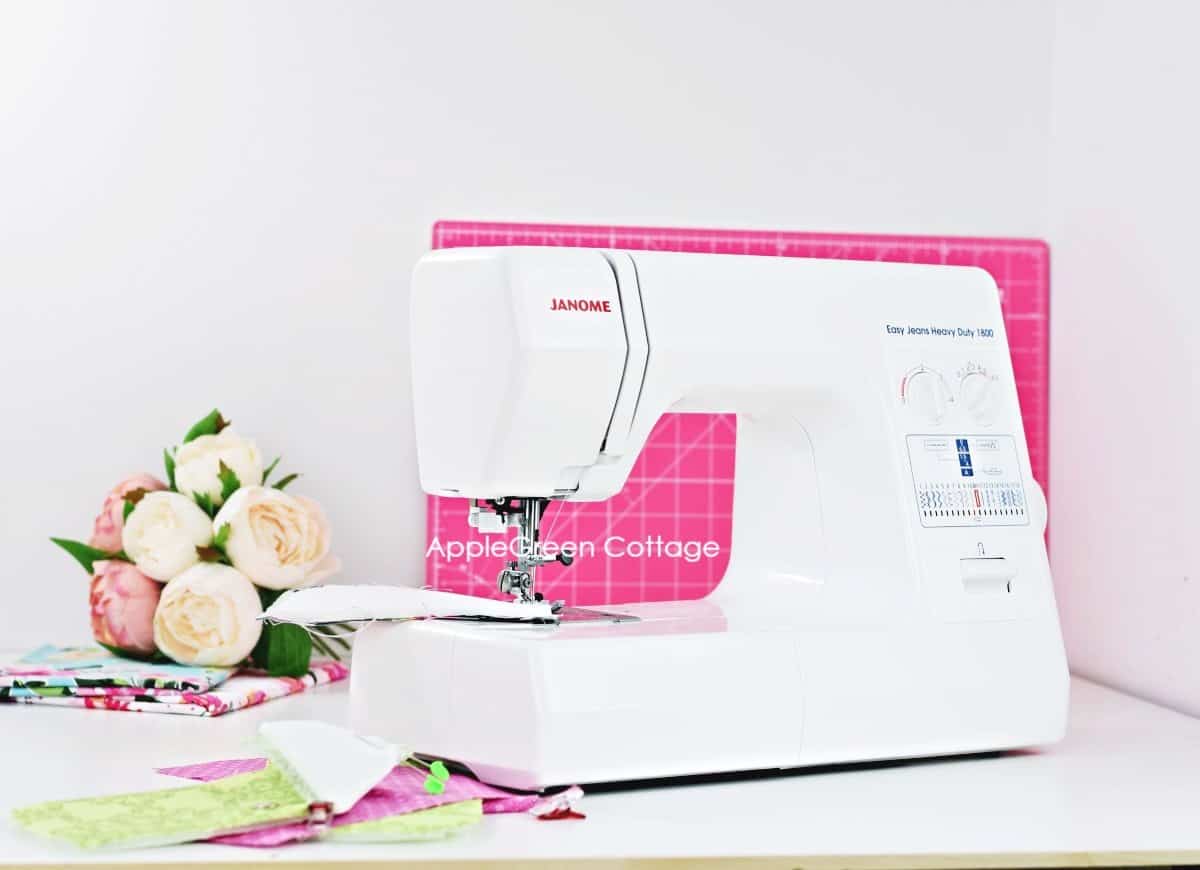
Pros:
- foot pressure adjustment - trust me, you'll want this one! You can adjust the foot pressure if you notice the seams puckering or uneven stitching when you change materials.
- 7-piece feed dog - helps prevent any fabric-feeding issues
- Top-load bobbin! Even though I love my front-loading bobbin on my previous sewing machine - oh how much EASIER it is to use the top-loading bobbin! Another bonus: it has a transparent cover, so I can see when I'm likely to run out of my bobbin thread, and replace it! (no more surprises, little bobbin!)
- maximum stitch width is 6.5 mm which is more than usual on a home sewing machine.
- there's a built-in needle threader. I've been changing the thread way too many times these weeks, just to see it in action. My eyes are rested!
- the presser foot lifts extra high. Not as high as with the industrial machines, of course, but still high enough for all the bags I want to sew.
PERKS:
- a see-through bobbin case cover, did I mention that!
- it has an organizer box on top of the machine for accessories, so you can have them all organized and ready to use. This is the place to store your presser feet, and needles. And the thread is nicely covered and secured from dust. I love this!
- in addition to the accessory, the machine also has the usual storage tray mounted next to the free arm.
There is a handy instructional guide located on the front of the machine. I love that the instructions are printed on the housing of the machine: the stitch options: on the front cover AND recommended stitch length plus the best-to-use sewing foot recommendation - right there on the front cover! It's a little bit like having the user manual printed on the machine, right before your eyes. Totally cool!
CONS:
That stitch selection red mark is small - I need to look pretty close to notice which one I have selected. It looks the same on Janome HD 3000 model too.
NOTE: You need to know that it has a 0.5 amp motor (55 Watt in Europe, with 220V) while I read that it had a 1.0 amp motor before. Janome must have changed that just a few years ago.
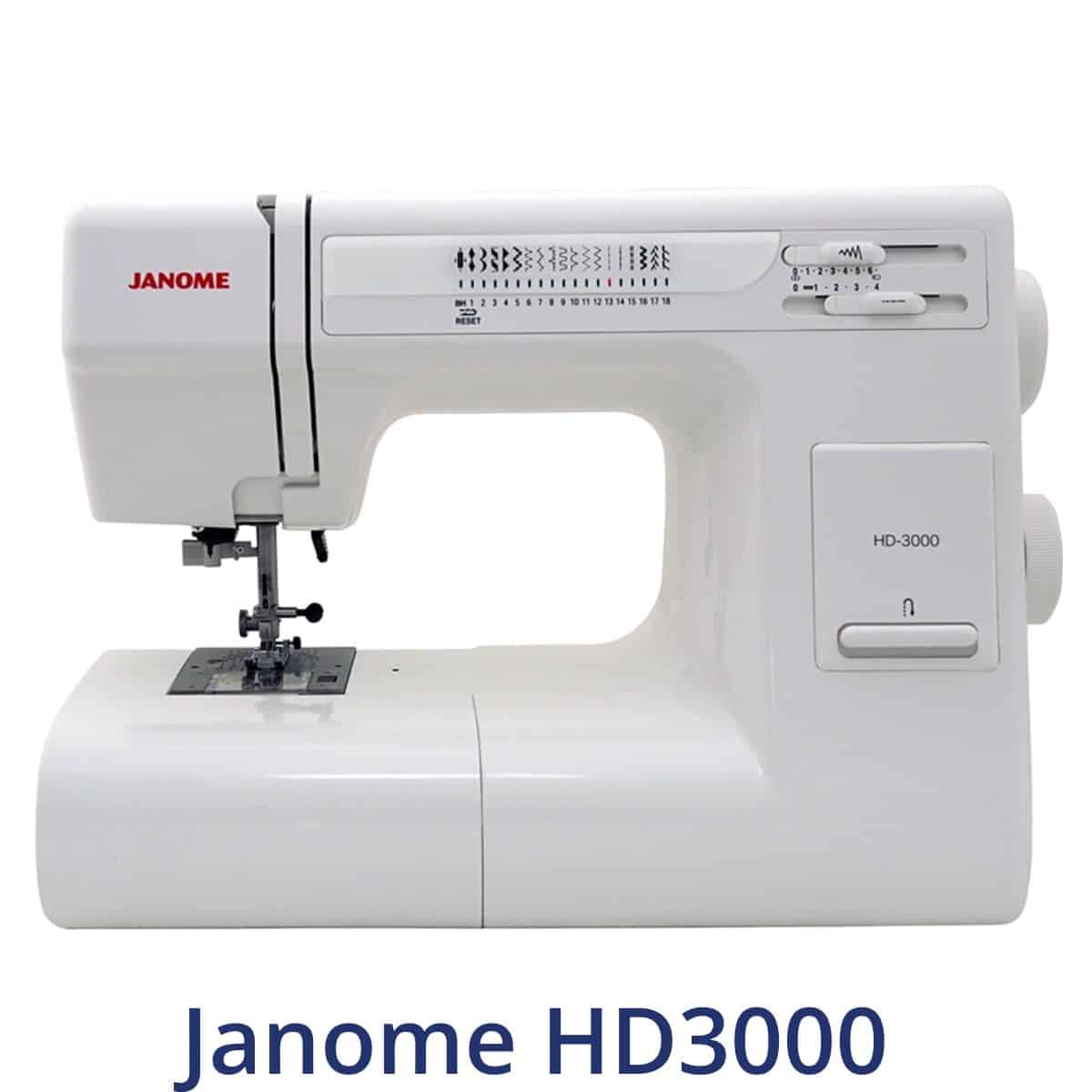
JANOME HD3000 HEAVY-DUTY SEWING MACHINE
Technical features:
- Weight - 23.2 lb
- Dimension - 16 x 7.2 x 11.3
- Body construction - die-cast aluminum
- Stitch speed - 860 spm
- motor 0.5 amp
- 5-piece feed dog
- top-loading bobbin
NOTE: You need to know that it has a 0.5 amp motor (55 Watt in Europe, with 220V) while I read that it had a 1.0 amp motor before. Janome must have changed that just a few years ago.
Sewing features:
- 18 built-in stitches
- reverse stitch lever
- built-in needle threader
- one-step buttonhole
- Extra high presser foot lift
- Foot pressure adjustment
- Maximum stitch width: 6.5mm
- Maximum stitch length: 4mm
Sewing machine feet included:
- zigzag foot 'A' - this one comes installed on the sewing machine
- transparent buttonhole foot 'B'
- overedge foot 'C' (the one with a brush)
- hemmer foot 'D'
- zipper foot 'E'
- blind hem foot 'G' (you can use it to stitch in the ditch)
- automatic buttonhole foot 'R'
A handy instructional guide is located in the top tray door of the machine, which indicates the feet and stitch settings for a variety of sewing tasks. Just like with HD1800 - great user experience! Also, a handy instructional guide is located on the front of the machine.
The usual storage tray is mounted on the machine's free arm, and it holds these accessories:
- a quilting ruler
- large and small screwdrivers
- a lint brush
- a seam ripper (buttonhole opener)
- one large and one small spool holder
- 4 extra bobbins
- an extra spool pin, with spool pin felt
Differences Between HD3000 and HD 1800
I've had the privilege to investigate, in detail, all the aspects of the two models, in particular their differences. What I realized was the only differences are in a few accessories that are included, and the button design. Here's what I've come up with:
- All major technical features are the same: the 0.5 amp motor (HD3000 had a 1 amp motor years ago), strength, housing, aluminium die-cast frame - the same.
- a difference in foot pedal: HD1800 has a dual speed pedal (you can switch on the slower speed for thick materials)
- difference in the stitch length and width buttons design: dials on HD1800 and sliders on HD3000.
- design difference in the reverse stitch lever: the one on HD3000 is a bit wider.
- HD1800 has 2 sewing machine feet that are not included with HD3000: satin stitch foot 'F' and straight stitch foot 'H'.
- On the other hand, HD3000 has one sewing machine foot that is not included with HD1800, and that is the hemmer foot 'D'
- HD1800 has 19 stitches, HD3000 'just' 18 - but trust me, you'll only need the zigzag and straight stitch 99% of the time.
A Design Difference between HD3000 and HD1800
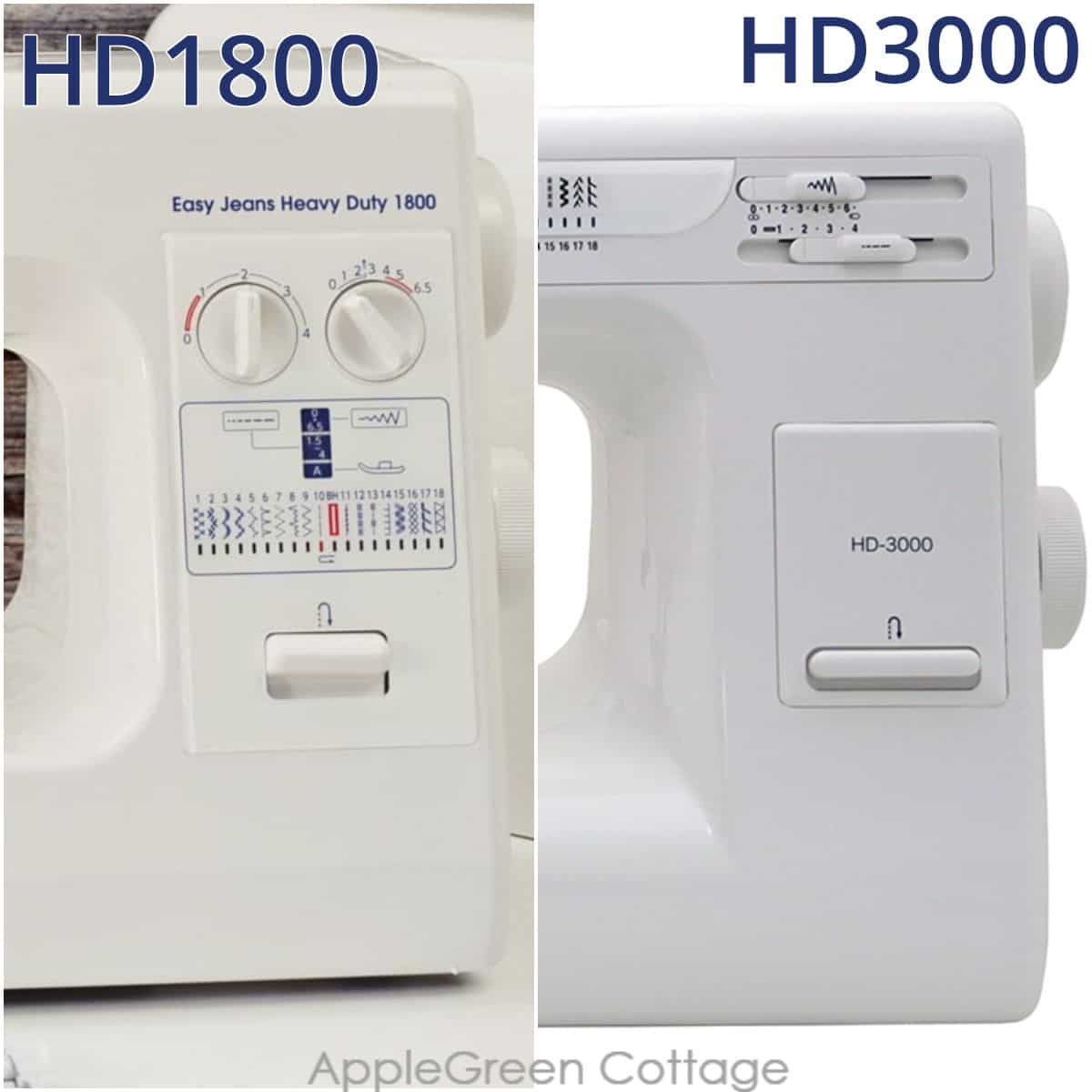
A slight design difference between HD 3000 and HD 1800: HD1800 has dials for the stitch selection. While I do prefer dials to the sliding buttons on HD3000, it's not a big thing.
Janome HD3000 vs Janome HD1000 comparison
Comparing to HD1000? The HD3000 and HD1800 both have a top loading bobbin, a better bobbin winder, and better feed dog assembly than HD1000, and both can stitch a wider zigzag than HD1000. If your budget allows, skip the HD1000 and head straight for 1800 or 3000.
Janome HD3000 has a one-step buttonhole option (cool!). Compared to the basic Janome HD1000 model (with only a 4-step buttonhole option), this is just one more reason to go with this popular choice, the HD1800/HD3000.
Weight of HD1000 is 15 lb, while HD3000 is 23,2 lb).
Soft cover with HD1000, hard cover with HD3000.
MAximum stitch width 5mm on HD1000, and 6.5mm on HD3000
Singer 4423 Heavy Duty Sewing Machine
Main features of the Singer 4423 heavy-duty sewing machine:
- The Singer 4423 Sewing Machine has a maximum sewing speed of 1,100 stitches-per-minute.
- It has a metal interior frame and a stainless steel bedframe
- 0.7 amp motor (which means a good, powerful motor for a budget hd machine)
Considering all these features, this sewing machine can sew through a variety of heavy-weight fabrics and provides long-lasting stability.
Accessories and use:
Sewing features:
- 23 built-in stitches including basic, stretch, decorative, and buttonhole stitches. I keep repeating that the number of stitches is not a decisive factor, still good to know.
- It has a built-in needle threader.
These machine feet are included:
- an all-purpose foot
- zipper foot
- buttonhole foot
- a button sewing foot.
The accessories included are similar to the ones that come with Janome HD 3000: a lint brush, quilting guide, needles, bobbins, a screwdriver, and an auxiliary spool pin with spool pin felt - you'll find them in the accessory tray. The machine comes with a soft-sided dust cover too.
Threading is easy, as it has guides, like the majority of sewing machines nowadays. It also features a one-step button hole option.
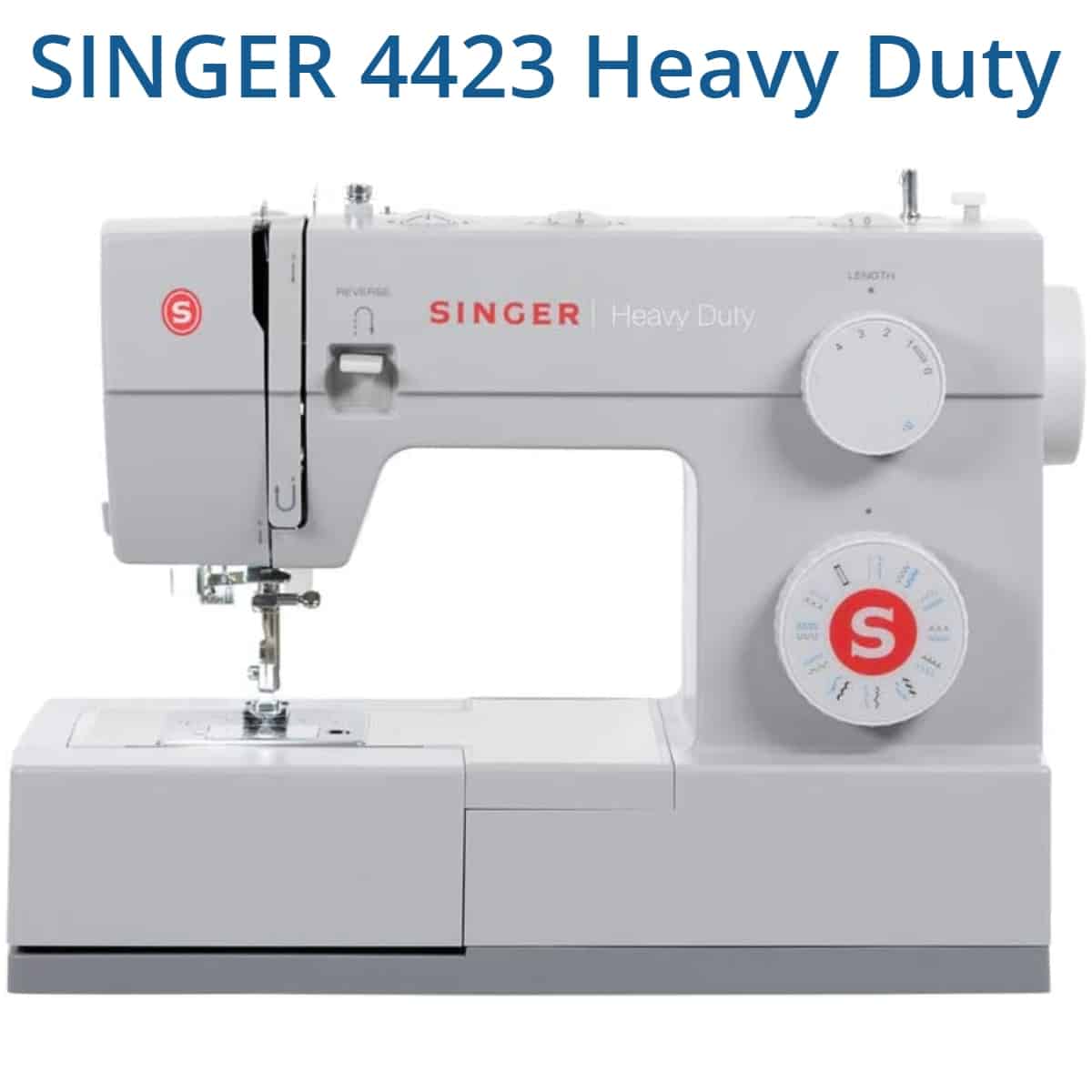
Singer 4423 vs Janome HD 3000
Singer 4423 is another of the machines that come to your mind whenever you think of a budget heavy-duty sewing machine. It's a solid heavy duty sewing machine that's also extremely popular on Amazon too. But it's a domestic heavy duty sewing machine with more plastic parts* then the Janome models. The frame is made of metal.
*plastic parts include: the handwheel drive, the dials have plastic wheels behind. The pressure regulator (on top of your machine) is made of plastic too (older Singers had a metal one). The tension system, the reverse lever, and the main gear on the gear drive is plastic too.
Again, I don't hold anything against a machine with plastic parts. In fact, there are plenty on my basic model, working just fine. But when choosing specifically a 'heavy-duty' one, one that has a stronger motor, I prefer as many internal bits as possible made from the good old metal. I'm from the ancient times I know 😀
Why I did not choose the Singer heavy duty sewing machine
I went forward and asked (a lot of questions) my local sewing machine dealer who sells various brands, and a lot of models. The service person said there was a whole different level of quality between the two - singer HD and Janome HD lines. I would get a way better deal with a Janome HD than with the Singer HD.
Then I asked (a lot of questions) someone who's well-versed in servicing both machines. That professional repairman would choose Janome HD over Singer HD, since the Singer model on average needs more parts replacements in that repair shop, and more servicing too. That was what made me decide to go with the Janome model.
Is Singer Heavy Duty Machine really heavy duty?
It is a popular, sturdy, quality domestic heavy-duty sewing machine that will work well for your regular sewing projects but not too heavy materials like leather, or, say, 5 layers of denim. It is serviceable, but you should not think of it as a machine parallel to industrial sewing machines. Yes it is stronger and heavier than the regular budget sewing machines, it has more metal and it will bring you through more sewing hours and through thicker materials than usual, regular, domestic machines. So it's a yes, it is a domestic HD machine.
Elna 3210 Easy Jeans (Also called Elna Easy Jeans)
Technical features:
- Stitch selection display
- reverse lever
- Built-in needle threader
- Strong needle penetration on all fabrics
- Rotary horizontal hook with transparent bobbin cover
- Automatic declutch bobbin winder
- Built-in thread cutter
- Drop feed dog
- Adjustable foot pressure
- Extra presser foot lift
- Clip-on presser feet
- Metric / inch measurements on needle plate and bobbin cover plate
- Free arm
- Carrying handle
- jeans bag / dust cover
Sewing features
- Number of stitches: 19 including 1 buttonhole
- Maximum stitch width 6.5 mm (same as the Janome!)
- Maximum stitch length 4 mm
- Needle positions variable
Sewing machine feet included: standard metal foot A, blind hem guide G, hemmer foot D, overlock foot C, satin stitch foot F, automatic buttonhole foot R, zipper foot E, buttonhole foot B.
Accessories: these are pretty much the same as with all the other models I mentioned before:
- 2 accessory storage areas
- bobbins
- needles
- quilting guide,
- an additional spool pin plus spool pin felt,
- large and small spool holders,
- a lint brush
- a screwdriver
- a seam ripper.
Both the Elna and the Janome models are equally easy to use for me, basic and simple, no computerized parts, and a major portion of these parts are metal parts, not plastic.
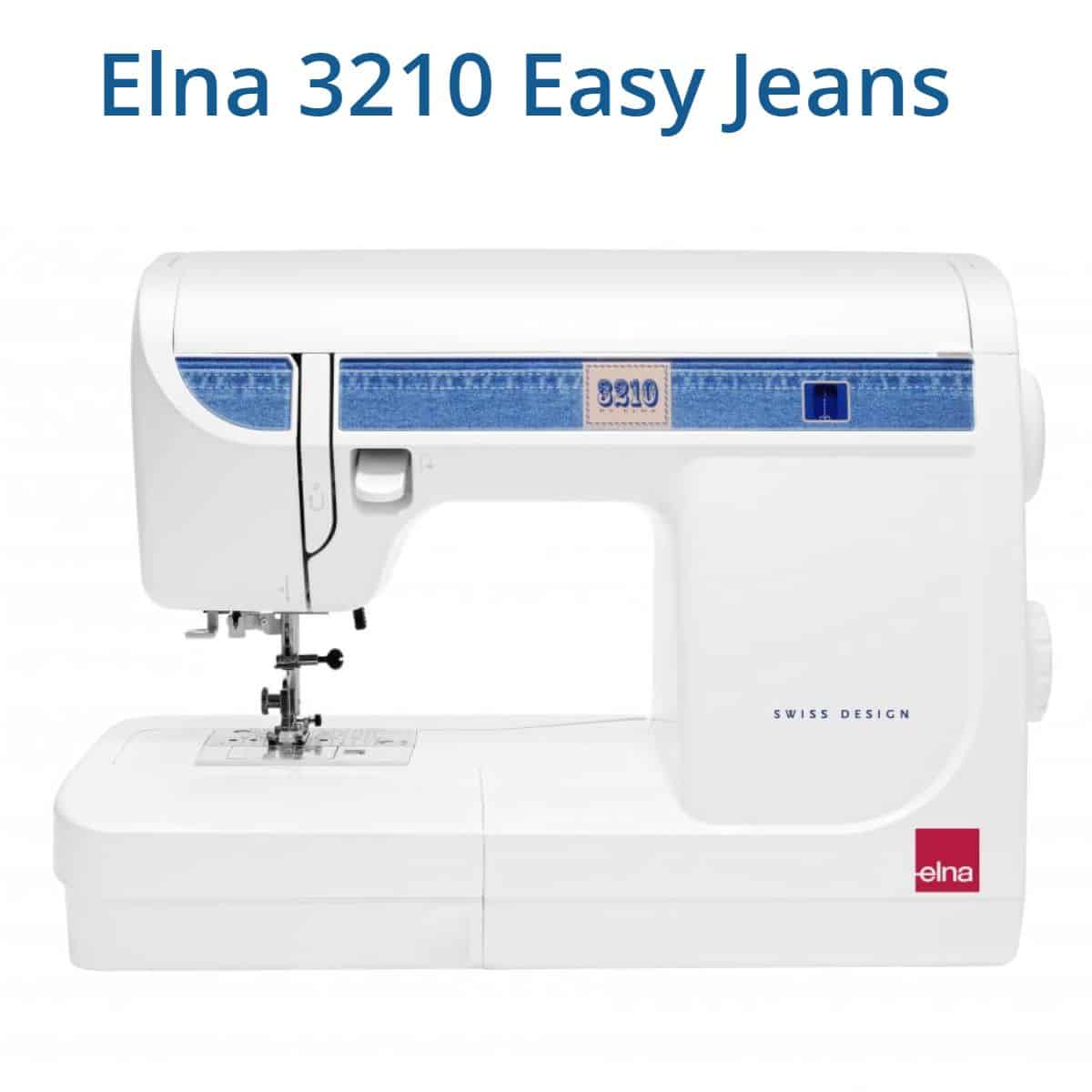
Elna 3210 Easy Jeans vs Janome HD1800
Elna 3210 Easy Jeans comes with practically the same features as the Janome HD 1800 and Janome HD 3000, including the top organizer box, top bobbin, needle threader, 0.7 amp motor, it is popular more in Europe than in the US. Of all the Elna models, this one was my top Elna heavy-duty sewing machine pick.
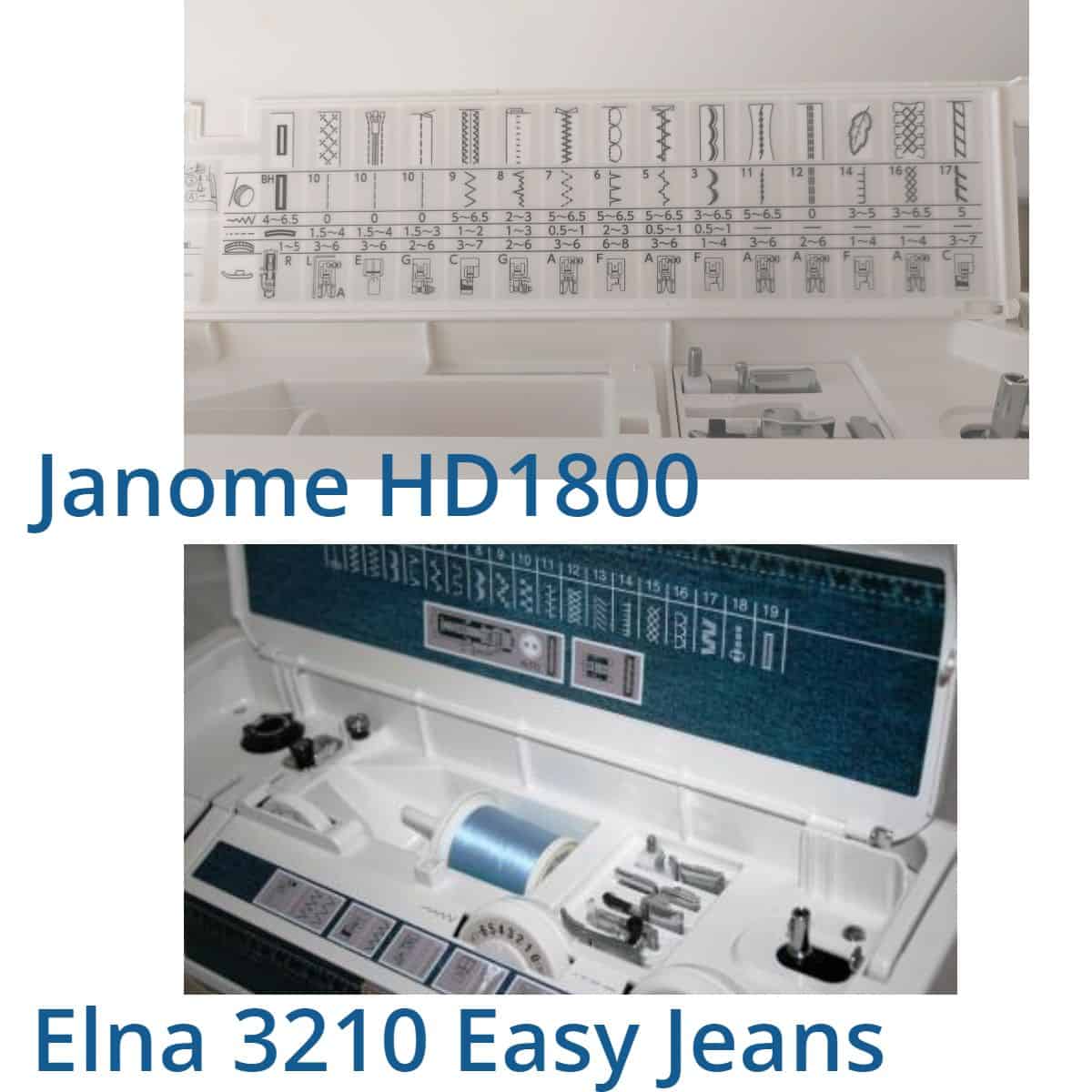
As already mentioned here and there on Applegreen Cottage, the Janome and Elna machines are both manufactured by the same company and have the same parts. This was very convenient for me when I transitioned from my basic Elna to a less basic Janome. No adjustment is needed, no learning curve. I did not need to search for buttons or dials (though I need to confess I am being spoiled by all the extra goodies on the new HD model, haha!)
Semi-Industrial Heavy Duty Sewing Machines
The gist: First, a note on Janome HD9, a semi-industrial heavy-duty sewing machine with amazing features (I use it daily!). It is designed for advanced users and is known for its speed and precision. As such, it is typically priced at a higher range. If you can spend more than a thousand USD on your machine, HD 9 is a great way to go. Since I'm a HD9 fan, I can be biased, but I'll add comparisons with other, Juki TL machines that many of my bagmaking friends use too.
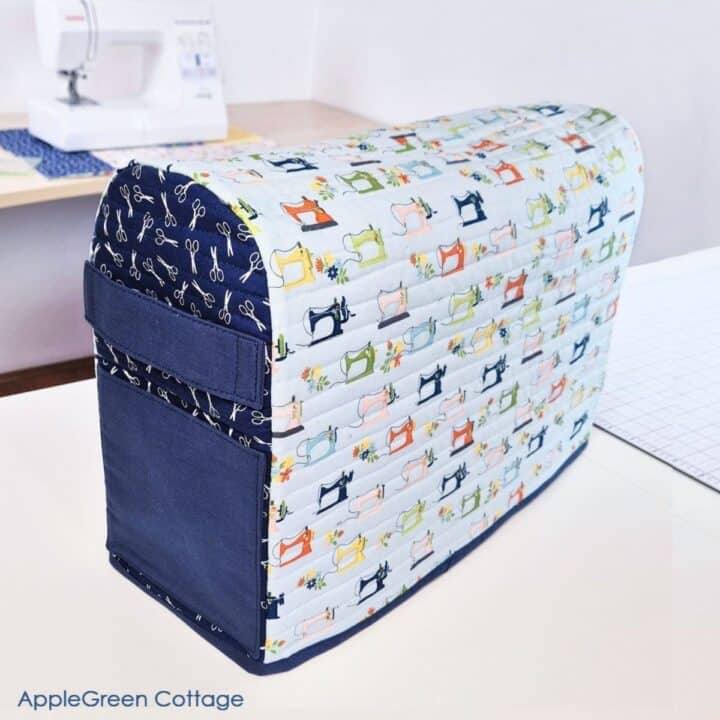
Make a dust cover for your new machine!
Make a cover using this free sewing machine cover pattern:
Please note that this part is still evolving. I'm always adding to it and working on a comparison of several more models as I get to know them.
Juki TL Straight-Stitch Sewing Machines
Juki TL-15, TL-18, TL-2000, and TL-2010 - all have
- the same aluminum die-casting body
- throat space 8 ½" by 6" tall
- all have a knee lift lever
- an extension table as standard equipment (590x335 mm)
- drop feed
- needle threader (not automatic!)
- bobbin - vertical hook rotary
- sewing speed 1500 SPM
- needle up and down position (Predetermined Stop Position of the Needle)
- 25.4 lbs
- Max stitch length 6mm
- No free arm (no sleeve sewing here!)
- Extra presser foot lift: up to 9 mm. (note to myself: doublecheck that!)
- Needle type: HAx1 (130/705H)#7-#18 (HLx5 #9-#16)
Juki TL-2010Q Straight-Stitch Sewing Machine
It's marketed as a quilting machine (the Q in the name stands for Quilting!) - but I have my eyes on it for bagmaking!
With an 1.4 amp motor, it's a workhorse. That's nearly 3 times the strength of my first, entry-level sewing machine.
Main Juki TL-2010Q Specifications
- Size: 17 ¾"L x 14"H x 8 ½"D (25"L x 18"H x 14"D with auxiliary table mounted and the spool holders in action)
- Auxiliary Table Dimensions: 23" x 13"
- Top Sewing Speed: 1,500 spm
- Max. Stitch Length: 0.2" (6mm),
- Max Presser Foot Lift 0.35" (9 mm)
- Weight: 25.4lbs
Top Features of Juki TL-2010Q:
- the 8 ½" throat space is super large, which makes both bagmaking and quilting so much easier!
- With a 1.4 amp motor, it is built to run for long periods of time. A real workhorse! (mind this is still less than the real industrial, servo-motor kind. Good, I don't need that one. Yet.)
- It's a heavy, semi-industrial, but still portable machine that can be put on a table. If you don't have space for a full industrial machine with a built-in table, this is a great option!
Edit: I am adding this option after doing an extensive research on bagmaking sewing machines. The minus on the Juki TL-2010Q is that like HD9 it only has a straight sttich, no zigzag, which might be a deterrent if you need one, single sewing machine for all your sewing projects. You won't be sewing jersey or sheer fabrics on this one, and neither finish raw edges using a zigzag. But oh my, she will sew fast, and steady through your bagmaking interfacing, and especially faux leather!
Juki TL-2000
It has no speed control and has no sub-tension control (good to have for thicker thread- important for bagmakers!), compared to all the other three Juki TL machines here.
Juki TL-2010Q vs Juki TL-15 Comparison
Basically the same. The only difference between these two machines is the design on the front, and TL-15 has a few additional accessories.
Juki TL-2010Q vs Juki TL-18 Comparison
The biggest difference.
TL 18 has a micro-lifter that enables you to lift the foot a little higher, when sewing with thicker materials. (Float function)
IT comes with a mounting base to attach gauges and binders.
TL-18 - you can switch off the light on it, it has a button. Good for filming sewing videos.
Juki TL-18QVP
Haruka TL-18QVP is a single needle, lock-stitch, portable sewing machine. No free arm.
Janome HD9
After careful research (and months of overthinking) I got me this one, and after nearly a year of use, I've finally collected all my thoughts my detailed review of Janome HD9 - see why I absolutely love this machine.
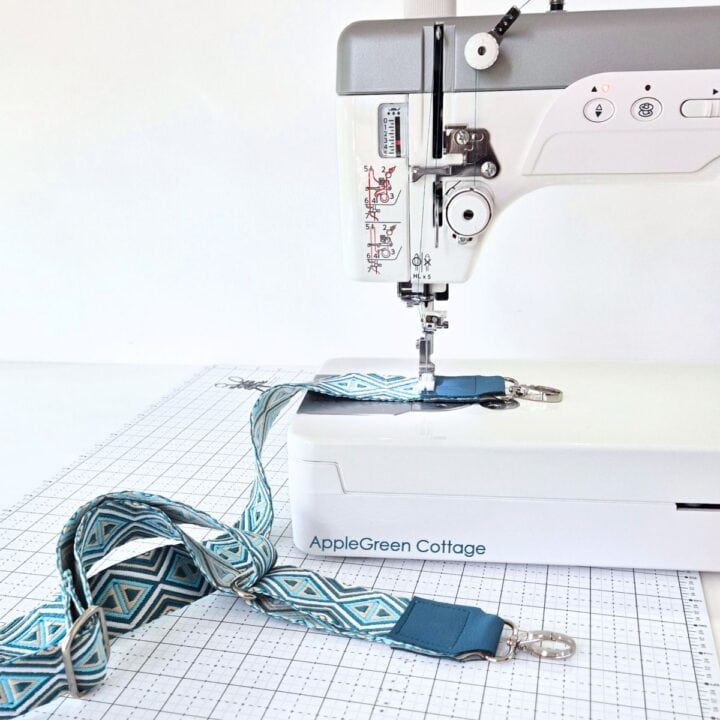
Janome HD9: Worth it? / Is Janome HD9 for you?
The pros, cons & must-knows.
Good to know: HD9 is a successor to the Janome 1600P-QC (But the 1600P-QC has no heavy-weight thread guide, so this one is definitely better!)
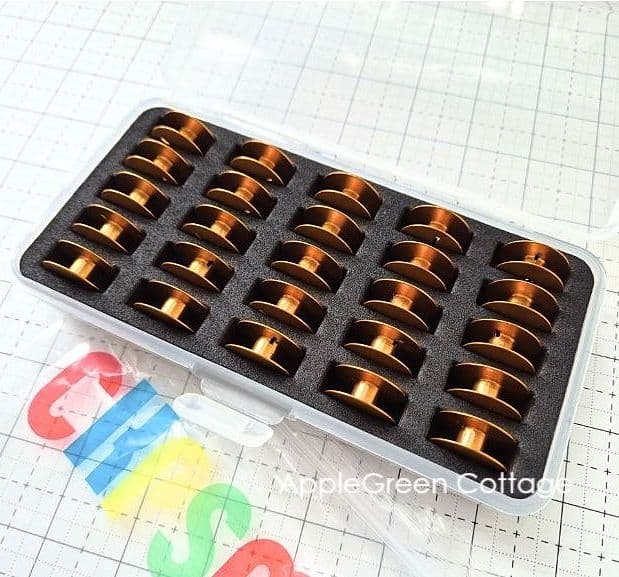
My HD9 Bobbin Fix!
This fixed my only Janome HD9 issue - jumbo bobbins at a great price (with a case!)
I hope this helps clarify things! If you want to dig a little deeper, see my detailed review of Janome HD9.
Juki TL-2010Q vs Janome HD9 Comparison
Pro Janome HD9:
- Light: better on Janome HD9
- foot pedal comfortable on Janome, not too practical on juki (if you accidentally press the heel down, the thread gets cut off!)
- mind the placement of the knee-lift, it's pretty central on Juki (might not work best for you)
- a bit faster, but both are super fast and have a speed control (Juki has a top stitching speed of 1500 SPM (Stitches Per Minute) while the Janome offers 1600 SPM)
- Extra presser foot lift: up to 12.7 mm (Juki TL 'just' 9 mm - check again, some sourse say Juki TL-2010Q goes higher than Janome HD9 with Juki!)
- it has a separate heavy weight thread guide, for that thick thread in bagmaking
- this one is the decisive factor: Janome HD9 might be able to deal with just a tiny bit thicker materials better than the Juki TL- 2010Q
Pro Juki 2010Q:
- pricing (though it's worth noting, the Janome HD9 is more affordable in Europe than in the US. Note: Always buy locally for plug compatibility!)
- Janome HD9 has no extension table added as standard equipment. (but you can buy one separately, there are 2 sizes)
- Both machines are provided with the thread tension scale, which allows you to adjust the tension according to the thread and material to be used. But, the Juki has a clear blue marking, on the Janome HD9 no clear marking (You have to look at the edge of the knob to see where the tension is. Just something to get used to.)
Service history (research!)
I spoke to the repair service manager at my local Janome HD9 dealer again. (It's the biggest seller of Janome machines in the area) They said that since the Version 2 was introduced, they have NOT yet had a SINGLE repairwork on a Janome HD9 V2.
Janome HD1800, HD2200 vs Janome HD9 motor power - Comparison
I finally understand the motor power difference between the two:
| Model | Voltage | Power (W) | Amps (A) |
|---|---|---|---|
| Janome HD2200/HD1800 | 230V (Europe) | 55W | ~0.24 amps |
| Janome HD2200/HD1800 | 120V (US) | 55W | ~0.46 amps |
| Janome HD9 | 230V (Europe) | 95W | ~0.41 amps |
| Janome HD9 | 120V (US) | 95W | ~0.79 amps |
Conclusion
I hope this post and review of the best heavy-duty sewing machines has helped you decide on your own perfect heavy-duty home sewing machine - or a professional/industrial one. (And judging from the photos above, you now know which machines I now own?) Happy sewing!
Want More Free Patterns?
Get email updates and never miss out on new patterns, printables, and tutorials:
Or check out this pretty ALLina project bag pattern in our shop - for all your storage needs:
Gina Fiedel says
Thank you for this fantastically detailed post. Super helpful. I'm looking to upgrade from my tired Kenmore 385 that can't handle the projects with heavier and bulky fabrics I tend to use. I am considering the Janome HD2200 or possibly going above my budget for the HD3000. Have you done a deep dive comparison on those two?
Alejandra Ruiz says
Thanks for this starting point, looking for a new machine makes you dizzy!!!!
Alexis says
Wonderful review. So much attention to detail. I want a machine and was dreading the mental load of choosing. I haven't been well. Thank you so much!